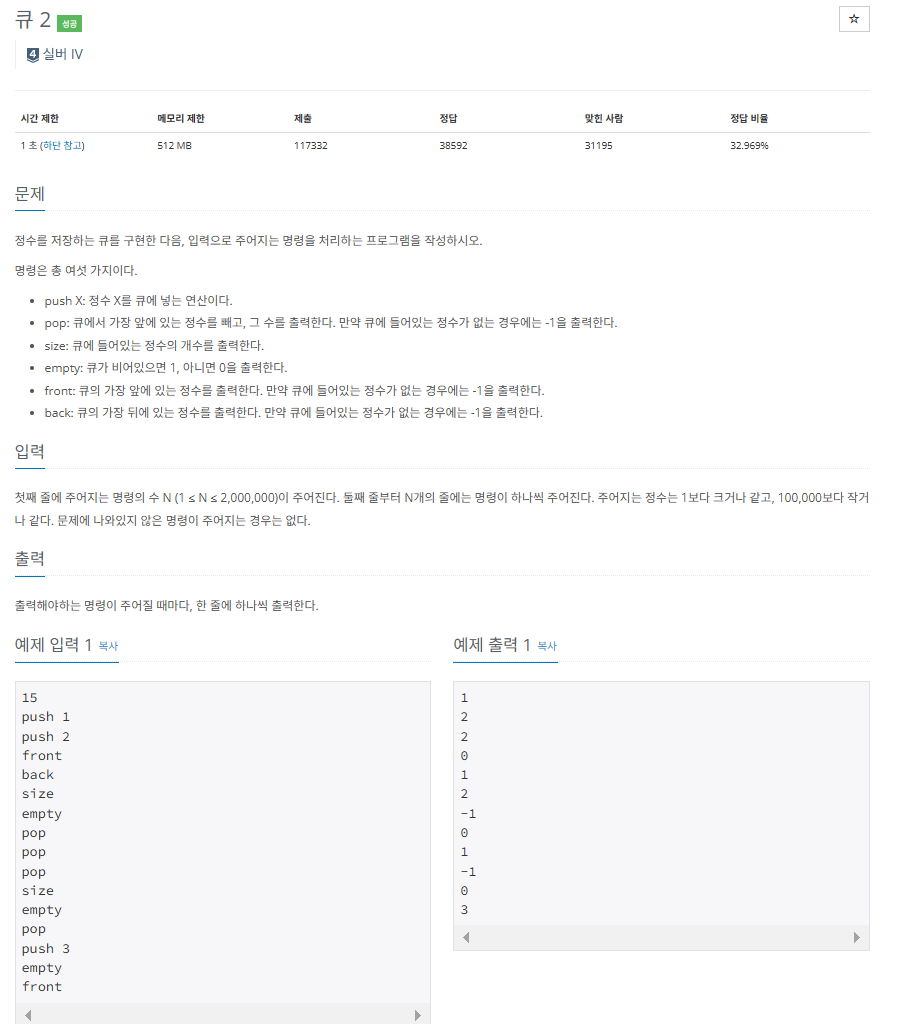
제출 코드
import java.io.*;
import java.util.*;

public class Main {
    public static void main(String[] args) throws Exception {
        BufferedReader br = new BufferedReader(new InputStreamReader(System.in));
        BufferedWriter bw = new BufferedWriter(new OutputStreamWriter(System.out));

        int N = Integer.parseInt(br.readLine());
        Deque<String> queue = new ArrayDeque<>();

        for(int i = 0; i < N; i++) {
            String[] command = br.readLine().split(" ");

            switch(command[0]) {
                case "push":
                    queue.addLast(command[1]);
                    break;
                case "pop":
                    bw.append(queue.isEmpty() ? "-1\n" : queue.pollFirst()+"\n");
                    break;
                case "size":
                    bw.append(queue.size()+"\n");
                    break;
                case "empty":
                    bw.append(queue.isEmpty() ? "1\n" : "0\n");
                    break;
                case "front":
                    bw.append(queue.isEmpty() ? "-1\n" : queue.peekFirst() + "\n");
                    break;
                case "back":
                    bw.append(queue.isEmpty() ? "-1\n" : queue.peekLast() + "\n");
                    break;
            }
        }

        br.close();
        bw.flush();
        bw.close();
    }
}
자바 ArrayDeque 내부로직
ArrayDeque는 원형배열 기반
초기 생성자
1. 내부 배열 크기 17로 초기화
Object[] elements;
int head;
int tail;

public CustomArrayDeque() {
    this.elements = new Object[[17];
}
push 로직
addLast(tail을 증가 시키면서 뒤쪽에 추가)
1. e == null이면 NPE 발생
2. tail 위치에 요소 추가
3. inc 의해 tail 증가
4. 배열이 가득 찼을 경우(this.head = inc()) grow 의해 크기 확장
public void addLast(E e) {
    if (e == null) {
        throw new NullPointerException();
    } else {
        Object[] es = this.elements;
        es[this.tail] = e;
        if (this.head == (this.tail = inc(this.tail, es.length))) {
            this.grow(1);
        }

    }
}

static final int inc(int i, int modulus) {
    ++i;
    if (i >= modulus) {
        i = 0;
    }

    return i;
}
addFirst(head를 감소 시키면서 값을 앞쪽을 추가)
1. e == null이면 NPE 발생
2. dec 의해 head 감소 후 요소 삽입
3. 배열이 가득 찼을 경우(this.head = this.tail) grow 의해 크기 확장
public void addFirst(E e) {
    if (e == null) {
        throw new NullPointerException();
    } else {
        Object[] es = this.elements;
        es[this.head = dec(this.head, es.length)] = e;
        if (this.head == this.tail) {
            this.grow(1);
        }

    }
}

static final int dec(int i, int modulus) {
    --i;
    if (i < 0) {
        i = modulus - 1;
    }

    return i;
}
pop
pollFirst(head값 출력 후 head값 증가)
1. head값 e에 저장
2. 값이 있을 경우 head 위치 값 null(GC) head값 증가
public E pollFirst() {
    Object[] es;
    int h;
    E e = (E)elementAt(es = this.elements, h = this.head);
    if (e != null) {
        es[h] = null;
        this.head = inc(h, es.length);
    }

    return e;
}

static final <E> E elementAt(Object[] es, int i) {
    return (E)es[i];
}
pollLast(tail값 감소 후 tail값 출력)
1. tail 값 감소(dec(this.tail, es.length)
2. tail값 e에 저장
3. e값이 있을 경우 tail 위치 null(GC)
public E pollLast() {
    Object[] es;
    int t;
    E e = (E)elementAt(es = this.elements, t = dec(this.tail, es.length));
    if (e != null) {
        es[this.tail = t] = null;
    }

    return e;
}
size
1. this.tail: 데이터 삽입될 위치(마지막 원소의 다음 인덱스)
2. this.head: 데이터가 제거될 위치(첫 번째 원소의 인덱스)
3. this.elements.length: 버퍼 배열의 크기
4. i-j 음수 일 경우 버퍼 크기 더함
public int size() {
    return sub(this.tail, this.head, this.elements.length);
}

static final int sub(int i, int j, int modulus) {
    if ((i = i - j) < 0) {
        i += modulus;
    }

    return i;
}
isEmpty
public boolean isEmpty() {
    return this.head == this.tail;
}
문제 의도
- 큐의 기본 동작 이해
'알고리즘' 카테고리의 다른 글
| 프로그래머스 12906번 | 같은 숫자는 싫어 문제 풀이 (Java) (0) | 2025.02.12 |
|---|---|
| 백준 10866번 | 덱 문제 풀이 (Java) (1) | 2025.02.11 |
| 백준 9012번 | 괄호 문제 풀이 (Java) (0) | 2025.02.11 |
| 백준 10828번 | 스택 문제 풀이 (Java) (2) | 2025.02.05 |
| 백준 10808번 | 알파벳 개수 문제 풀이 (Java) (2) | 2025.02.03 |


